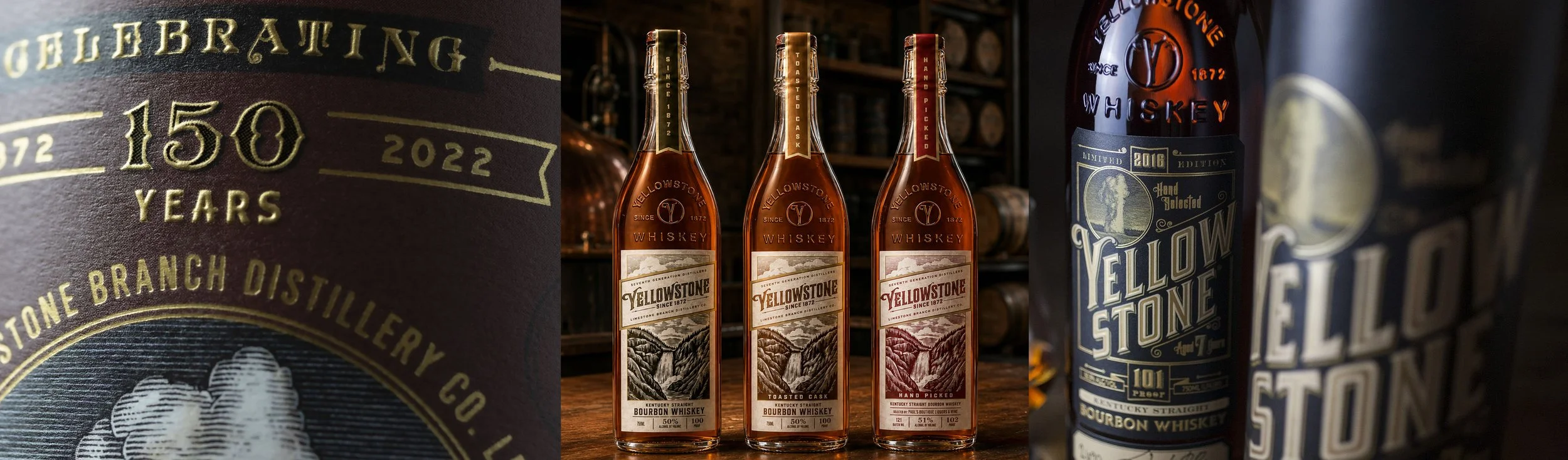
Portfolio Structure Audit & ArchitectureBRINGING CLARITY TO A COMPLEX PORTFOLIO
Yellowstone Bourbon was preparing for a packaging evolution, but the design problem was only one part of a much larger strategic question.
The portfolio contained several distinct product groupings: a core Heritage Collection, barrel-finished offerings, customer-selected single barrels, an annual Limited Edition series, and a proposed historically-inspired Recollection Series. Alongside the packaging redesign, the brand was considering new bottle structures, existing glass inventory, and evaluating whether certain products or entire collections should migrate into different bottles.
These decisions carried consequences well beyond aesthetics, including consumer perception, brand hierarchy, manufacturing costs, existing inventory, portfolio clarity, and the flexibility to accommodate future line extensions.
The growing number of possible configurations had made it increasingly difficult to establish a clear path forward.
THE APPROACH
Rather than beginning with the redesign of individual packages, the first step was to examine the architecture of the portfolio itself.
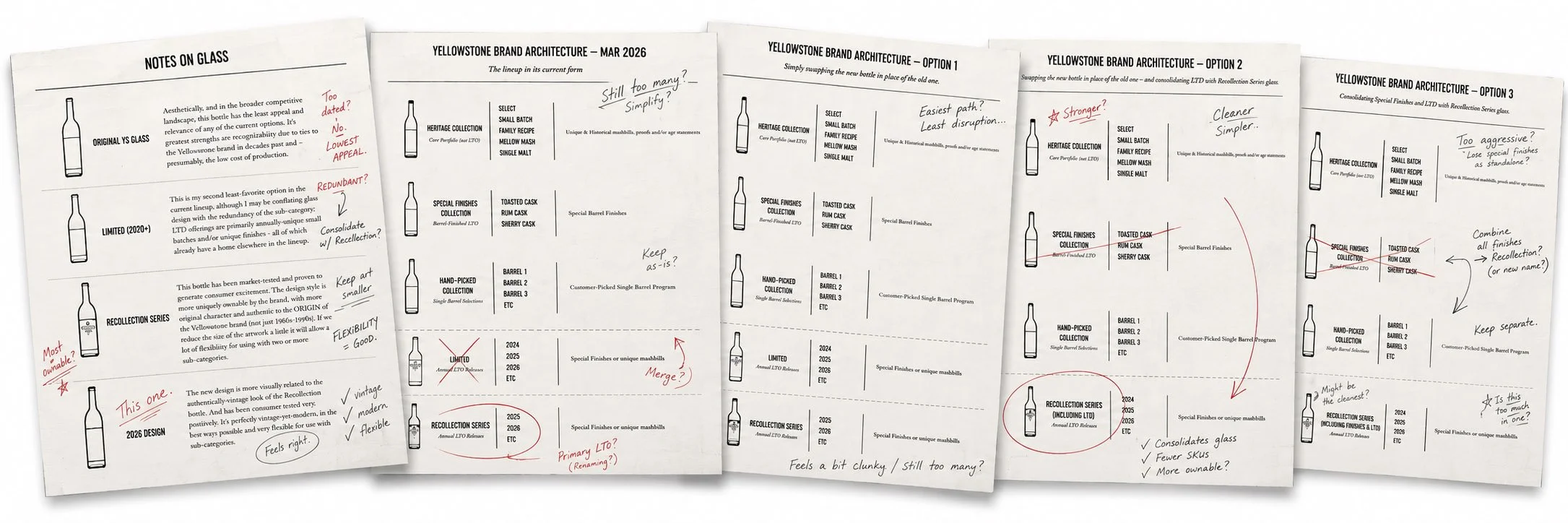
A visual brand-architecture study mapped the existing portfolio and modeled six alternative organizational systems, exploring different relationships between the Heritage Collection, Limited Edition releases, the proposed Recollection Series, special finishes, single-barrel programs, and existing or proposed glass structures.
The six scenarios ranged from relatively conservative glass substitutions to more ambitious consolidation strategies. Each represented a different balance of brand positioning, product hierarchy, operational efficiency, and long-term flexibility.
THE VALUE
The objective was not to start by prescribing a single solution, but to make the implications of each potential direction visible and understandable.
Instead of navigating a convoluted tangle of SKUs, bottles, collections, and future possibilities across a series of meetings, leadership could evaluate clearly articulated alternatives side by side.
The study provided the marketing team with a tangible decision-making framework to bring to senior leadership, allowing the broader portfolio strategy to be evaluated before committing resources to package design, tooling, inventory, and production.
With the portfolio structure, organizational logic, and roadmap established, the subsequent design work proceeded within a coherent strategic framework.
The resulting portfolio architecture established a clear foundation for the development and execution of an award-winning packaging design system.